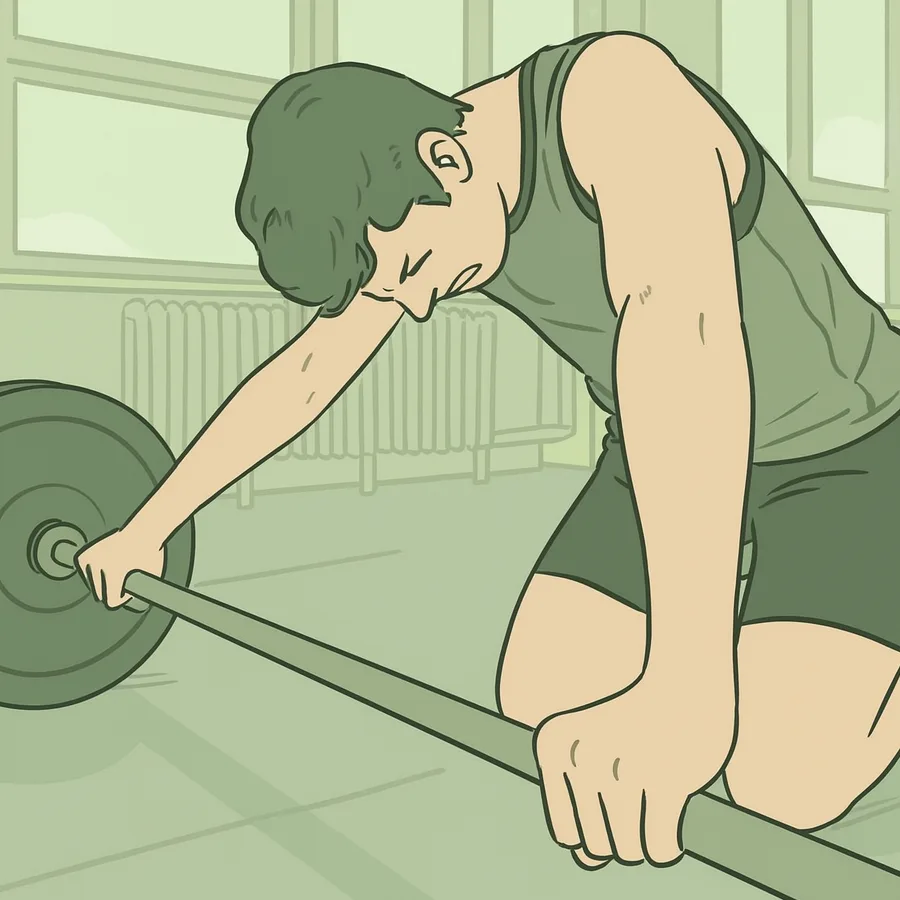
You can spend hours lifting weights, building your biceps, and running regularly, yet still never become truly athletic. After all, an impressive physique doesn't necessarily guarantee strength, speed, or endurance. Here are four common mistakes that can prevent you from reaching your full physical potential and turning your muscles into genuine functional strength.
Picture this: you go to the gym regularly, know exactly how much your barbell weighs, remember your personal best on the bench press, and almost automatically calculate the protein content of every meal. On the outside, everything looks great: your shoulders have become broader, your arms more muscular, and your T-shirts fit completely differently. But there's a catch: try sprinting a short distance, jumping onto a high platform, or performing a few sudden movements, and you might discover that your body isn't quite as ready for physical activity as you thought.
The problem may not be a lack of strength, but rather the wrong approach to training. Many men focus exclusively on building muscle mass, forgetting about speed, coordination, explosive power, and mobility. As a result, they develop an impressive physique but not necessarily a body capable of performing effectively in different situations.
True athleticism is about more than big muscles and a defined six-pack. It's the ability to react quickly, push off powerfully, control your body, change direction, and use your strength not only in the gym but also in everyday life.
1. You're Too Focused on Building Muscle
Big biceps, broad shoulders, and a muscular back are great motivation to hit the gym. That's why most popular workout programs revolve around squats, presses, rows, and other compound exercises. They're excellent for building muscle mass and strength, but they can't provide complete physical conditioning on their own.
If you spend months performing only slow, controlled strength exercises, your body gradually adapts to that specific type of workload. You may become stronger in certain exercises, but that doesn't necessarily mean your movement speed or ability to generate maximum force instantly will improve.
An athletic body needs to do more than lift heavy weights. It needs to lift them quickly, too. That's where explosive power comes in: the ability to generate significant muscular force in a very short amount of time. It's essential for jumping, sprinting, dynamic team sports, and many other physical activities.
What should you do?
- Add explosive exercises to your program, such as box jumps, kettlebell swings, medicine ball throws, and other movements that require you to generate force quickly.
- If you already have sufficient training experience, perform these exercises at the beginning of your workout, before fatigue sets in.
- If you're a beginner, start by mastering the technique and preparing your muscles and joints. There's no need to jump straight into maximum-intensity jumps or complex movements.
- Gradually increase the difficulty, but never sacrifice proper form just to squeeze in more repetitions.
One important detail: explosive exercises should be performed with maximum movement quality, not until complete exhaustion. If your speed drops and your technique starts to deteriorate, it's better to take a break.
2. You're Trying to Make Up for Everything with Hundreds of Reps
There's a widespread myth that the more repetitions you perform, the better athlete you'll become. This is especially common with functional training, jumping exercises, and bodyweight workouts. Some people turn every session into a competition against themselves, trying to complete as many movements as possible in the shortest amount of time.
But explosive power doesn't develop according to the principle of "the more, the better." Its foundation is precision, speed, and control. When you perform jumps while already exhausted, land awkwardly, or lose your balance, the benefits of the exercise decrease, while the risk of injury may increase.
For example, five properly executed box jumps can be more effective for developing explosive power than twenty rushed repetitions performed with poor technique.
What should you do?
- Focus on performing every movement correctly rather than counting repetitions.
- Perform jumps with controlled landings, making sure you maintain your balance.
- Pay attention to every phase of the movement: takeoff, flight, landing, and returning to the starting position.
- Take sufficiently long breaks so that your next repetition is just as technically sound as the previous one.
Remember this simple rule: if your goal is to develop speed and power, every repetition must be performed with the highest possible quality. Your workout shouldn't turn into a chaotic race to rack up numbers in your training log.
3. You Skip the Warm-Up Because You Want to Get Straight to the Weights
It's a familiar scene: someone walks into the gym, drops their bag, heads to the bench, and immediately starts lifting heavy weights. Why waste time warming up when those minutes could be used for an extra set?
In reality, this is one of the worst habits you can develop in your training routine. After sitting for a long time or going through ordinary daily activities, your body may not be ready for intense exercise. Jumping straight into heavy lifts makes it harder for your muscles, joints, and nervous system to adapt to the workload.
A warm-up helps gradually increase exercise intensity, prepare the necessary muscle groups, and rehearse movement patterns before the main part of your workout. This is especially important before sprints, jumps, heavy squats, and other exercises that require speed and control.
What should you do?
- Start with a few minutes of light activity, such as walking, easy jogging, or cycling on a stationary bike.
- Add dynamic movements to prepare your joints and muscles for the upcoming workout.
- Before your main strength exercise, perform a few warm-up sets with lighter weights.
- If you're planning to sprint, begin with an easy jog and gradually increase your speed.
There's no need to turn your warm-up into a separate workout. Its purpose is to prepare your body for exercise, not exhaust it before your first serious set.
4. You're Relying Exclusively on Cardio
Treadmills, stationary bikes, and elliptical machines are all excellent tools for developing cardiovascular endurance. Regular cardio helps support heart health, improves overall fitness, and allows you to stay active longer without feeling exhausted.
But there's one problem: steady-paced running or long sessions on a stationary bike don't develop every physical ability equally. If your goal is to become faster, more powerful, and more agile, cardio alone isn't enough.
Athletic fitness requires a variety of training stimuli. Your body needs to learn not only how to work for extended periods at a moderate pace but also how to switch quickly to intense movements, recover afterward, and generate force again.
What should you do?
- Add interval training to your routine, alternating short periods of intense effort with recovery periods.
- Try sprints, high-intensity intervals on a stationary bike, or workouts on a rowing machine.
- One option is to alternate 20 seconds of intense effort with 40–60 seconds of rest.
- Start with a small number of intervals and gradually increase the workload according to your fitness level.
For example, 8–10 intervals can be a useful guideline for someone who is already well-trained, but this isn't a universal standard. Always take your fitness level, health condition, and exercise intensity into account.
What Should a Workout for a Truly Athletic Body Look Like?
If you want more than just a good-looking reflection in the mirror and also want to feel strong, fast, and fit, you need to approach physical conditioning as a whole. An ideal program doesn't have to be complicated or include dozens of exercises. What matters is that it develops different physical abilities rather than focusing on just one.
A balanced training plan should include:
- Strength exercises. Squats, presses, rows, and other fundamental movements help build muscle mass and strength.
- Explosive movements. Jumps, medicine ball throws, and kettlebell swings train your ability to generate force quickly.
- Cardio training. Running, swimming, cycling, and other activities help maintain endurance and support cardiovascular health.
- Coordination and mobility. Balance exercises, movement-control drills, and mobility work help you gain better control over your body.
- Recovery. Sleep, proper nutrition, and rest days give your body the opportunity to adapt to training demands.
You don't need to develop every physical ability in a single workout. It's better to distribute your training load intelligently throughout the week while allowing enough time for recovery. If you're just starting out, learn new exercises gradually and, if necessary, consult a coach who can help you create a safe and suitable program.
A Strong Body Is About More Than Big Muscles
Muscle mass, a defined six-pack, and broad shoulders can be the impressive result of consistent hard work. But true physical fitness goes far beyond what you see in the mirror. It shows when you can accelerate quickly, jump confidently, maintain your balance, lift a heavy object, and stay in control of your movements.
So don't turn the gym into an endless race to lift heavier weights and perform more repetitions. Add variety to your workouts, work on your technique, don't forget to warm up, and make room for explosive power training. It's the combination of different physical abilities that helps build a body that doesn't just look good but can actually perform.
And remember: the best measure of your fitness isn't just the number on the barbell or your reflection in the mirror. It's how confidently, quickly, and efficiently you can use your body in real life.