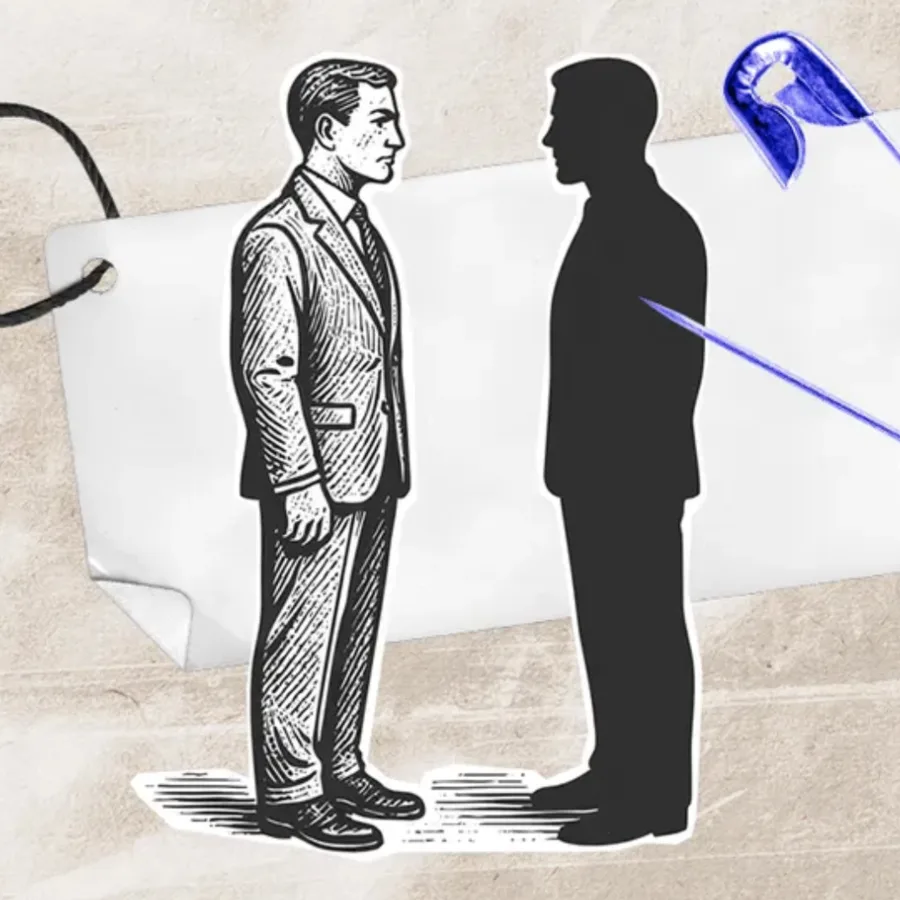
In life, people are constantly trying to tell a man who he is.
“You’re a clown.”
“Without this job, you’re nobody.”
“You have to prove that you’re smarter.”
“You simply don’t understand anything.”
At first, it sounds like an offhand remark. Then it gets repeated. And eventually, in a strange way, it begins to influence your behavior.
That is the real danger of labels: they don’t just describe you — they offer you a role. And if you agree to play that role for long enough, you can eventually forget where other people’s opinions end and your real personality begins.
In adult life, respect rarely falls from the sky. It isn’t built by having a loud voice, wearing an expensive watch, or being able to win every argument. Most often, it starts with something much simpler: a sense of self-respect.
That is exactly why there are certain labels you should tear off immediately.
“You’re a clown”
A sense of humor is a powerful weapon.
A man who knows how to make a well-timed joke, ease tension, or defuse an awkward situation almost always has a social advantage. But the problem begins when jokes become the only thing people expect from you.
At first, they call you the life of the party.
Then they start saying, “Come on, tell us something funny.”
Eventually, serious conversations start without you because everyone has become used to seeing you as the group’s entertainment.
That is a dangerous role. A man can be an excellent joker while still being serious, reliable, and thoughtful. But if you constantly play the clown, people eventually stop looking for anything else in you.
Don’t perform on demand.
Sometimes the strongest thing a man can say is precisely the thing he chooses not to say.
“You have to help everyone”
Helping others is good.
Being someone people can rely on is even better.
But there comes a point when being willing to help turns into voluntary servitude.
You stay late at work. You take on other people’s tasks. You solve other people’s problems. You cover for those who simply don’t want to do their jobs. In relationships, you constantly compromise so that nobody gets offended.
Then one day, you notice something interesting: people no longer ask you to do things — they simply expect you to do them.
And that is a crucial difference.
A good person knows how to say “yes.” A strong person also knows how to say “no.”
You don’t need to become everyone’s personal emergency service. If your kindness can be exploited without limits, someone will eventually take advantage of it.
“You have to prove it”
This is one of the most insidious labels.
You’re told that you’re not successful enough. Not strong enough. Not smart enough. Not man enough.
And then you’re offered a simple solution: prove it.
Prove to her that you’re better than her ex.
Prove to your colleagues that you deserve the position.
Prove to your friends that you can afford an expensive car.
Prove to some stranger online that he’s wrong.
The problem is that a game without rules never ends.
You buy a more expensive car — and an even more expensive one appears. You get a promotion — someone else earns more. You win one argument — and another one is already waiting.
If your sense of self-worth depends on constantly having to prove something, you are already playing by someone else’s rules.
“You don’t understand anything”
This is where many men fall into the trap.
A group is discussing politics, the stock market, football, art, cars, or some trendy new technology. You don’t know much about the subject.
And that is completely normal.
No one can know everything.
But instead of simply saying, “I don’t know much about this,” a man may start feeling ashamed of his own ignorance. He nods along, pretends to understand, repeats other people’s words, and Googles unfamiliar terms simply so he won’t look like an outsider.
That is exactly what you shouldn’t do.
Not knowing something is nothing to be ashamed of. Pretending to know something you don’t understand is far worse.
Real confidence allows you to say calmly:
“I don’t know. Tell me about it.”
Sometimes that sentence sounds far more intelligent than twenty minutes of confidently delivered nonsense.
“You have to win this argument”
No.
Not every conversation is a battle.
Not every person you talk to is an opponent.
And not every provocation deserves a response.
There is a normal discussion: people exchange arguments, listen to one another, and may even change their minds.
Then there is a verbal fight whose purpose is completely different — not to find the truth, but to humiliate the other person.
At that point, arguments quickly run out. In their place come sarcasm, insults, twisting people’s words, and personal attacks.
And here is one simple thing you need to understand:
if someone doesn’t want to understand you but simply wants to defeat you, participating in their game is already their victory.
Sometimes walking away from an argument isn’t weakness.
It’s self-control.
“You’re too sensitive”
This label is particularly convenient for people who don’t want to take responsibility for their own words.
You say something upset you — “You’re too sensitive.”
You react to disrespect — “You take everything too personally.”
You set a boundary — “It’s impossible to talk to you normally.”
Of course, sometimes we really do overreact. You have to be capable of admitting that.
But someone else’s judgment of your reaction does not automatically mean you are wrong.
A mature position sounds different:
“Maybe I reacted too strongly. But that doesn’t mean you can treat me however you want.”
That is what adult self-respect looks like — without hysteria, but also without self-humiliation.
“You have to be a real man”
One of the oldest labels of all.
You have to be strong.
Never be afraid.
Never ask for help.
Earn more.
Don’t complain.
Always know what to do.
Never show weakness.
The problem is that there is no universal instruction manual for being a “real man.”
Strength doesn’t mean the absence of fear.
Confidence doesn’t mean the absence of doubt.
And courage isn’t about constantly demonstrating aggression.
Sometimes the most masculine thing you can do is admit that you were wrong. Sometimes it means leaving a toxic relationship. Sometimes it means asking for help. And sometimes it simply means refusing to fight a battle someone else is trying to force you into.
“You’re not the same anymore”
This label is often used by people who have become attached to an older version of you.
You stop trying to please everyone — “You’ve changed.”
You start saying “no” — “You’ve become selfish.”
You change jobs — “You’ve gotten too big for your boots.”
You stop drinking with the guys every Friday — “You’re not one of us anymore.”
But a person has every right to change.
In fact, never changing can be a much more worrying sign.
You don’t have to remain the man you were at 20 simply because someone liked that version of you.
“You’re not good enough”
This is no longer just a label.
It is an entire system of measurement in which you are destined to lose.
You think you need to earn a little more.
Build an even better body.
Dress better.
Know more.
Be more attractive to women.
Win one more time.
And then — finally become “good enough.”
Except that day will never come.
Because the criteria will keep changing.
Healthy ambition says: “I want to become a better version of myself.”
Low self-esteem says: “I have to become someone else in order to deserve my own respect.”
Those are two completely different things.