Today, we rely on skilled professionals, navigation apps, delivery services, and smart devices. It’s convenient, but it comes with an unexpected side effect: some practical skills have become rare hobbies, while abilities that were once part of everyday life now seem almost exotic. Let’s take a look at 15 skills men used to learn from an early age but often have to rediscover today.
1. Splitting Firewood Instead of Just Watching Videos About It
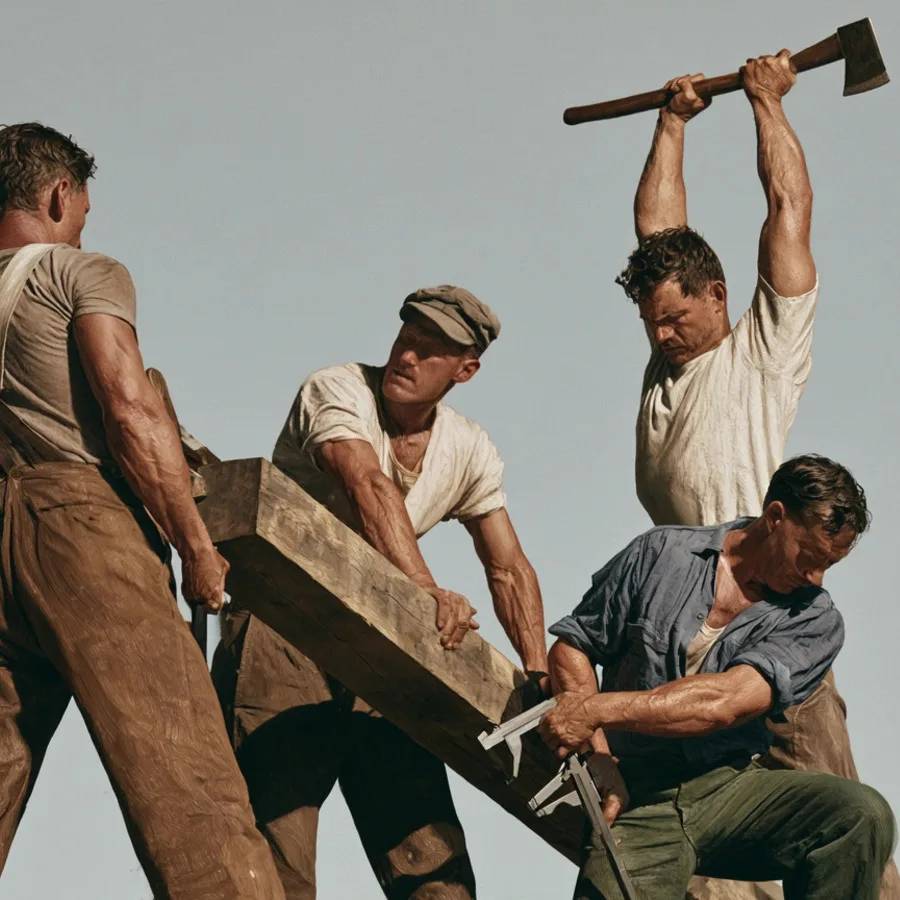
At first glance, it seems simple: grab an axe, swing, and you’re done. In reality, splitting wood skillfully requires technique, a good eye, and an understanding of how wood is structured. An experienced man knows how to spot cracks, account for knots, position the log correctly, and choose the right tool for its thickness.
What matters here is precision, not brute strength. A well-placed strike splits the wood, while a poorly aimed one wastes energy, time, and patience. Working with an axe also teaches discipline: a moment of carelessness can have serious consequences.
2. Mowing Grass with a Real Scythe
Today, a lawn mower does almost all the work by itself. In the past, men headed out into the meadows with scythes and could work for hours at a steady pace.
The secret lay in proper posture, a smooth movement of the torso, and a well-sharpened blade. The scythe had to be adjusted to suit the user's height, and the blade needed to be peened and sharpened when necessary. With the right technique, the tool cuts grass with very little wasted effort.
It’s a great example of how skill can beat strength. It’s also a reminder that the most effective tool isn’t always the one with a battery and a dozen buttons. Sometimes, it’s simply the one you know how to use properly.
3. Understanding the Land and Plowing a Field
Working with a plow required more than physical endurance. A man had to guide the animal, control the direction of travel, and keep the plowshare at the correct depth. The land offered little forgiveness for carelessness: an uneven furrow could make subsequent cultivation more difficult and reduce crop yields.
Today, tractors and advanced agricultural systems handle this work. Yet a basic understanding of soil, seasons, and natural cycles remains valuable. Knowing where our food comes from is also part of being practically self-reliant.
4. Harnessing and Saddling a Horse
For our ancestors, a horse was a means of transportation, a helper on the farm, and a working partner all at once. Knowing how to saddle a horse properly or harness it to a cart was therefore an essential practical skill.
A man needed to understand the purpose of straps, buckles, and stirrups, distribute the load correctly, and make sure the equipment did not rub against or injure the animal’s skin. Just as important was understanding the horse’s behavior, recognizing signs of fear or agitation, and handling the animal safely.
Today, these skills are mainly needed by riders, farmers, and people who work with horses. But they still illustrate an important principle: true competence means taking responsibility not only for yourself but also for those who depend on you.
5. Butchering Game and Working with Hides
For a hunter or someone running a traditional farm, bringing down an animal was only half the job. They also needed to know how to butcher the carcass properly, preserve the meat, and prepare the hide for future use when necessary.
These tasks required anatomical knowledge, sharp tools, and great care. Processing hides involved various methods of cleaning, preserving, and tanning. One mistake could ruin valuable material that had taken considerable time to prepare.
For most men living in cities, this is no longer an everyday skill. Yet it perfectly illustrates a culture of resourcefulness: in the past, materials were valued, reused, and not thrown away simply because a newer model had appeared.
6. Repairing a Car with Your Own Hands
In the past, a road trip could turn into an impromptu mechanics lesson on the side of the road. Drivers learned how to change a tire, check fluid levels, diagnose common problems, and figure out where a suspicious noise under the hood was coming from.
Some enthusiasts could repair engines themselves, adjust carburetors, and set the ignition timing. Modern cars are far more complex: electronics, sensors, and specialized equipment have turned many repairs into jobs for professionals.
Still, basic skills remain useful. Knowing how to change a tire, check tire pressure, use jumper cables safely, or recognize the signs of a serious mechanical problem can still save the day. And sometimes, save your wallet, too.
7. Sharpening Tools Instead of Complaining That They’re Dull
A knife, axe, chisel, or hand saw works well only when it is properly maintained. In the past, men regularly used sharpening stones, files, and abrasive blocks to keep their tools in good working condition.
It was important to maintain the correct angle, avoid overheating the metal, and understand what each blade was designed to do. A tool that is too dull doesn’t just make work harder; it can also be more dangerous because it requires greater force and is harder to control.
Today, professional sharpening services are widely available, but knowing how to maintain your own tools is still a valuable skill. Besides, there’s a special satisfaction in restoring an old tool to its former effectiveness.
8. Building and Crafting with Wood
Before building materials and power tools became widely available, woodworking required genuine craftsmanship. A skilled carpenter had to know how to measure, mark, hew logs, fit pieces together, and create strong joints.
Traditional timber construction used complex joinery that made it possible to build many structures without metal fasteners. Precision, knowledge of wood properties, and an understanding of how wood responds to moisture and temperature changes were essential.
Of course, not every man needs to build his own house. But knowing how to fix a shelf, make a simple bookcase, or build something useful for the home is a perfectly realistic goal. It’s also a satisfying way to prove to yourself that your hands are good for more than scrolling through a feed.
9. Soldering and Repairing Household Items
Until a few decades ago, repairing radios, televisions, and other electronic devices was a familiar task for many technically minded men. A soldering iron, solder, and basic electrical knowledge could help restore connections and replace faulty components.
Modern technology has become more compact, more complex, and often less suitable for home repairs. Manufacturers use integrated components, specialized fasteners, and software restrictions. In some cases, repairing a device simply isn’t cost-effective.
Even so, basic repair skills remain useful: replacing a simple part, restoring a connection in a suitable low-voltage device, or identifying the source of a fault. The key is to follow safety rules and avoid experimenting with household electrical wiring unless you have the necessary training.
10. Finding Your Way Without GPS
Imagine your smartphone runs out of battery, the internet goes down, and your navigation app stubbornly tells you to turn back toward a road that no longer exists. What would you do?
In the past, men navigated using paper maps, compasses, terrain features, and natural landmarks. They learned to determine direction, estimate distances, remember junctions, and match a map to the landscape around them.
This doesn’t mean trees always point reliably south or that you can easily find any route by looking at the stars. Natural signs require knowledge and can be misleading. That’s why maps and compasses remain reliable tools—as long as you know how to use them.
When hiking, these skills can be much more than a nice bonus. They can be an important part of staying safe.
11. Shaving with a Straight Razor
Today, most men choose cartridge razors or electric shavers. In the past, shaving with a straight razor was a daily ritual that required calmness, precision, and a steady hand.
The blade had to be prepared properly and, when necessary, stropped on a leather strap. During the shave, it was essential to control the angle and direction of each movement. One overly sharp movement or moment of inattention could result in a cut.
Today, this is more of a tradition for enthusiasts of classic shaving than an essential male skill. Still, it comes with its own philosophy: take your time, pay attention to the details, and don’t turn even an ordinary morning ritual into a mindless routine.
12. Writing Neatly and Legibly by Hand
In the past, handwriting was an important part of personal style. Letters, documents, and notes were written by hand, and neat penmanship demonstrated patience, attention to detail, and respect for the person who would read the text.
Calligraphy required control over writing pressure, smooth pen movements, and an understanding of letterforms. Even ordinary, legible handwriting was useful: it made it easier to jot down ideas quickly, create lists, and leave clear messages.
Computers have made writing faster, but they haven’t eliminated the need to express thoughts clearly. A handwritten postcard or note can sometimes make a much stronger impression than a dozen messages in a messaging app.
13. Tying Knots and Weaving Useful Items
A strong knot is a small feat of engineering. When tied correctly, it can secure a load, fasten a rope, hold equipment in place, or connect parts of a structure.
Sailors, fishermen, hunters, and builders knew different types of knots and understood when to use them. Some could be untied easily after being loaded, while others formed loops or securely joined two ropes together.
These skills also included hand-knotting fishing nets, weaving wicker baskets, and making other everyday items. Such activities required patience, fine motor skills, and attention to detail.
Today, knowing a few basic knots is useful for camping, repairs, travel, and everyday life. It’s also much more practical than heroically wrapping a rope around something ten times and hoping the whole structure holds.
14. Starting a Fire in Difficult Weather Conditions
A lighter and a gas stove make life much easier for campers. But what happens when the firewood is wet, the wind is picking up, and the matches are in another pocket?
Knowing how to start a fire begins long before the first spark. You need to find dry tinder, protect it from the wind, arrange the kindling properly, and ensure there is enough airflow. An experienced person knows that large logs won’t help much if there are no small, dry twigs to get the fire going.
It’s also essential to follow fire-safety rules: build a fire only where it is permitted, never leave it unattended, and extinguish it completely before leaving.
This is one of those skills best learned through practice in safe conditions—not when the temperature is already dropping and dinner is still raw.
15. Training Your Memory Instead of Relying on Your Smartphone
In the past, people remembered dozens of phone numbers, addresses, routes, and important dates. Not because everyone had extraordinary abilities, but because they exercised their memory regularly and couldn’t instantly look up every piece of information online.
Today, smartphones handle many tasks: they store contacts, remind us about appointments, plan routes, and keep shopping lists. It’s convenient, but we often don’t even try to memorize certain information anymore.
There’s no need to abandon technology or memorize an entire phone book. Simply train your memory deliberately: remember important numbers, read without constant distractions, summarize what you’ve read in your own words, and try to recall information yourself before searching for it online.
Digital devices can store data for us, but they shouldn’t do our thinking for us.
Have Modern Men Really Lost Their Practical Skills?
Not entirely. We haven’t become weaker simply because we split less firewood or no longer know how to harness a horse. The world has changed, and so has the set of skills needed for everyday life. Today, men may be much more likely to need digital literacy, the ability to work with information, financial responsibility, and the skill of negotiating with other people.
The problem doesn’t begin when you can’t repair an engine. It begins when every breakdown, household task, or unexpected situation automatically becomes a problem you don’t even feel capable of trying to solve.
True independence doesn’t mean being able to do everything yourself. It means understanding how basic things work, not being afraid to learn, knowing your own limits, and seeking professional help when the time is right.
Perhaps the best male tradition worth bringing back isn’t the ability to build a cabin with a single swing of an axe, but the habit of passing knowledge on. Learn something yourself, show it to your son, nephew, or friend, explain how a tool works, and let someone else have a go.
After all, maturity isn’t measured by how many tasks you can complete without anyone’s help. It’s measured by how confidently you can handle yourself when help is genuinely needed.