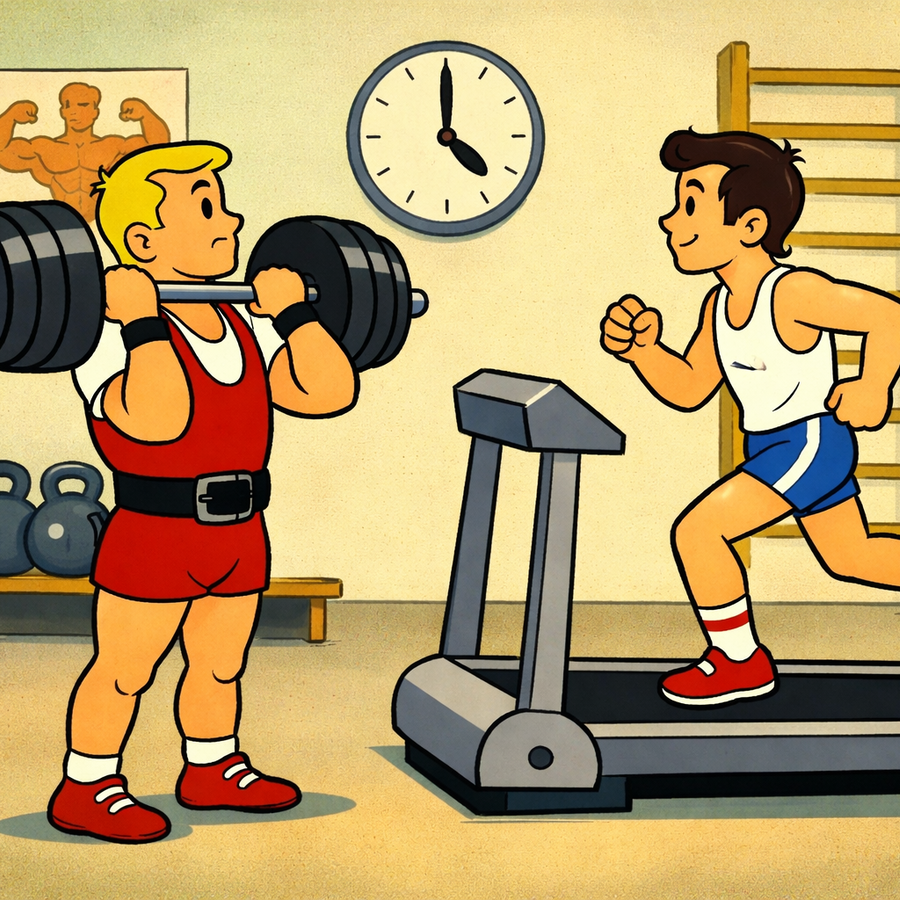
There is an endless debate that lives in every gym louder than the background music: what matters more — the treadmill or the barbell?
Some are convinced that the heart must be “powered up with cardio”.
Others believe that a real man only ages with a barbell in his hands.
But if you remove emotions, mirrors, and ego from the locker room, science is fairly clear:
no single type of training wins. The combination does.
And yes, it’s a boring answer. But it works.
Cardio: not about “getting lean for summer”, but about your life capacity
Cardio is not punishment for yesterday’s pizza.
It is a system that directly affects your survival.
Running, cycling, swimming, brisk walking — all of this trains your heart and blood vessels to not give up too early.
The better your aerobic fitness, the lower your risk of early death — and this is not motivation talk, but a solid scientific conclusion.
And the most interesting part:
even about 1 hour of cardio per week already produces a noticeable effect.
No marathons. No daily suffering.
Just one hour of movement you can realistically sustain.
Weights: what keeps you “in shape” with age
If cardio is the engine, strength training is the structure.
After age 30–35, muscle mass gradually declines if you don’t train it.
And with muscle you lose things more important than appearance:
— ability to lift, carry, and move without pain
— resistance to illness
— independence in older age
Studies show that higher muscle strength is linked to lower mortality risk, regardless of age.
Key point:
strength training is not about “getting big”.
It’s about “not falling apart too early”.
Main mistake: treating cardio and weights as rivals
Many people think like this:
— either you run and “burn calories”
— or you lift weights and “grow”
But the body never signed a contract separating its systems.
Heart, muscles, joints, hormones — it’s one system.
And it works best when you avoid extremes.
What large studies say (briefly)
Cardio
About 1 hour per week of moderate or intense activity already reduces mortality risk.
The optimal range goes up to about 3 hours per week.
Strength training
Just 30–60 minutes per week reduces the risk of death and chronic diseases by 10–17%.
Together
Those who combine both types of training get the best results.
The idea is simple: systems don’t compete — they reinforce each other.
The longevity formula without fanaticism
Not a fitness cult. Not a military regime. Just a realistic minimum:
Cardio:
60–150 minutes of moderate activity per week
or 75 minutes of intense activity
Strength training:
at least 2 sessions per week for major muscle groups
That’s it.
No heroics. No self-destruction. But consistency.
Why the combination works better than a “preferred style”
Cardio gives you endurance to live longer in the literal sense.
Strength training gives you a body that doesn’t break too early.
One without the other is like a car with a powerful engine but a weak frame.
Or the opposite — a solid frame with no fuel to go far.
An important male truth rarely talked about
The most dangerous thing is not skipping workouts.
It’s extremes.
When a person:
— does nothing at all
— or suddenly “starts a new life on Monday”
The body doesn’t like revolutions. It likes consistency.
If you haven’t trained in a while — don’t go “beast mode”
If you have blood pressure issues, heart problems, blood sugar issues, or haven’t trained in a long time — start slowly.
Cardiologists have been saying this for years:
strength training is safe and beneficial as long as you’re not trying to prove you’re a Terminator at the gym.
Your goal is not to break yourself in the first week.
It’s to build a system that lasts longer than your motivation.