There are topics men can talk about for hours: sports, work, cars, or money. But as soon as the conversation goes a little deeper, the direction changes sharply. Libido, erection, confidence in bed. And this is exactly where excess weight often becomes that “invisible player” no one wants to think about.
Even though, at times, it is precisely this factor that determines much more than it seems.
Fat is not just an energy reserve
Forget the old idea of fat as a “calorie storage unit.” In reality, it is an active hormonal organ that constantly influences the entire body.
And the more of it there is, the more strongly it interferes with the male regulatory system.
In adipose tissue there is an enzyme called aromatase. Its function sounds harmless, but the consequences are serious: it converts testosterone into estrogen. In simple terms, the male hormone is gradually “switched off,” and the hormonal balance shifts against you.
This is not theory. This is biology.
When testosterone drops — everything changes
Testosterone is not only about sex. It is about energy, mood, focus, muscles, and the feeling of “being in control of your life.”
When its level decreases, the changes usually come quietly:
- less desire
- lower confidence in bed
- faster fatigue
- irritability
- feeling “out of shape”
And the most dangerous part is that all of this is easily attributed to stress, work, or age.
Many men live like this for years without realizing that the cause may be metabolic, not psychological.
Erection is not about mood. It is about blood vessels
A common myth says: if there are erection problems, it is “nerves.”
In reality, erection is a vascular process. If blood vessels do not work properly, the body cannot provide a stable response.
Obesity causes systemic inflammation, damages blood vessels, and gradually disrupts circulation. Often, intimate life issues appear before the first serious cardiovascular symptoms.
And it is important to understand: sometimes it is not about age, but about the condition of the body.
The psyche is involved too
There is another level that is discussed less often.
When a man is dissatisfied with his body, his behavior changes: less initiative, more internal control, less relaxation.
Add social pressure, mirrors, comparisons — and you get a background that slowly “eats away” at desire.
Then stress chemistry takes over: cortisol rises, testosterone drops. The body shifts into saving mode instead of pleasure mode.
A vicious cycle many men know
The logic is simple and somewhat uncomfortable:
excess weight → stress → cortisol → lower testosterone → less desire → more stress
And so on.
That is why the problem rarely disappears on its own.
But there is good news: it is reversible
It is not a sentence, and not “forever.”
Even a 10–15% weight reduction can:
- increase testosterone
- improve vascular function
- restore energy
- bring back libido
And this is not magic, but basic physiology starting to work in your favor again.
The body loves movement — especially strength training
There is a reason the gym changes not only the body but also the mindset.
Strength training:
- boosts testosterone
- improves blood circulation
- reduces fat
- restores a sense of control over the body
And often this is where the return begins — not only of shape, but also of confidence.
Nutrition and sleep — underestimated “players”
No need for strict diets. But ultra-processed food, lack of protein, and chronic sleep deprivation all work against the hormonal system.
Sleep is especially critical: at night the body restores hormonal balance. If this does not happen, desire also suffers.
An important truth without moralizing
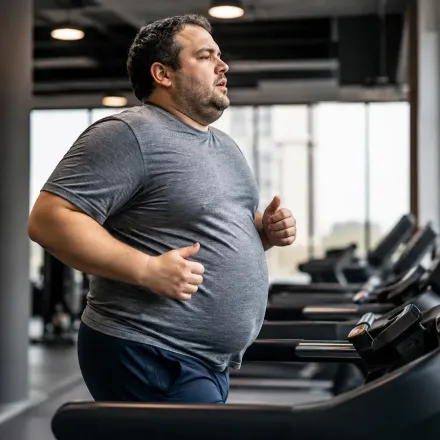
Obesity is not a lack of willpower and not an aesthetic issue.
It is a condition that changes body chemistry, affects blood vessels and hormones, and even shapes how you perceive yourself as a man.
And the sooner you start addressing it, the faster the body restores what seems lost.
Not motivation. But normal system function.